Your Guests Remember the Slam Before They Remember the Menu
Here’s something most restaurateurs don’t think about until it’s too late: the sound of cabinet doors closing during service.A server grabs napkins — bang. The host restocks wine glasses — bang. Kitchen staff pulls extra flatware from the backup station three meters from the dining room — bang, bang, bang.Your guests can’t always pinpoint what felt off. They just know the evening didn’t feel as polished as the menu promised. Next time they book a table, they pick somewhere else.
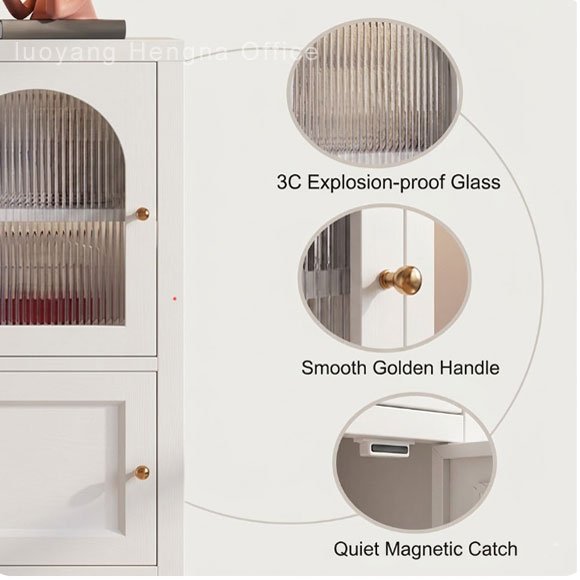
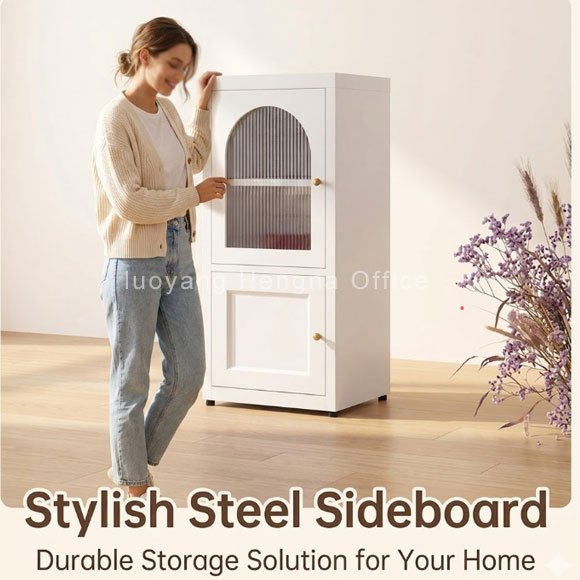
The reeded glass buffet cabinet solves this with one mechanical detail: it closes silently. A magnetic soft-close catch draws the door shut from 15mm away — no spring to weaken, no hydraulic damper to leak, just consistent, quiet closure that works the same on day one and day one thousand.
What a Dining Room Cabinet Actually Needs to Survive
A residential sideboard and a commercial dining room cabinet share almost nothing except a rectangular shape. Restaurant front-of-house storage has four non-negotiable requirements that most off-the-shelf cabinets can’t satisfy simultaneously.
Proximity to Kitchen Heat and Humidity
In many restaurants, the backup storage cabinet sits within three meters of the kitchen pass. Steam, grease particles, and temperature swings are constant.
Cold-rolled steel doesn’t absorb moisture. It doesn’t warp, swell, or delaminate. MDF and particleboard — the standard materials in most “commercial” cabinets at this price — start showing edge separation within six months in these conditions. This isn’t a quality issue. It’s physics.
High-Frequency Daily Use
A home cabinet opens 2–3 times per day. A restaurant prep cabinet opens 30–50 times. Standard butt hinges develop play in 3–6 months. Spring-loaded hinges lose tension within a year.
The magnetic soft-close mechanism in this buffet cabinet contains no fatigue-prone springs. The closing force comes from a magnetic field, which doesn’t degrade with repetition. In commercial service environments, this translates to years of consistent, silent operation without adjustment.
Upper Display, Lower Concealment
Restaurant storage is never a binary choice between “show everything” and “hide everything.” It’s always a split: some items should be visible, others shouldn’t.
The upper section features a reeded glass door — the vertical ribbing transmits color and shape while softening the details of what’s inside. Wine glasses, specialty bottles, and chef-selected ingredients look presentable without requiring perfect staging every time the housekeeping or service team passes by.
The lower section is a solid steel door. Table linens, backup supplies, cleaning equipment — close it and it’s invisible.
Narrow Enough for Tight Corridors
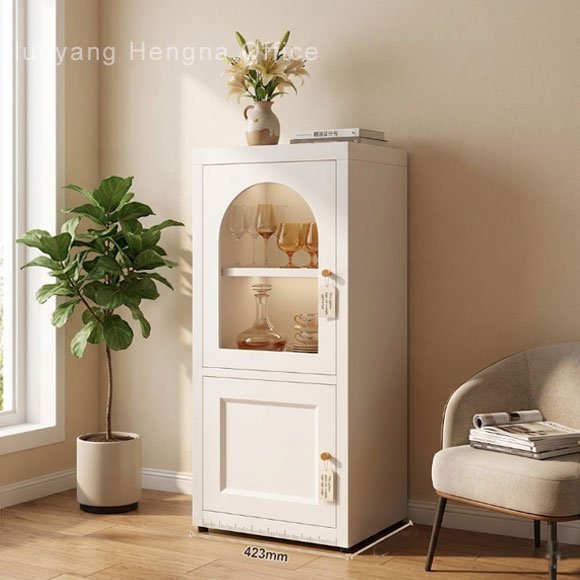
At 423mm wide with no protruding hardware, this buffet cabinet fits along hallway walls where servers pass during service without catching elbows or apron strings.
Steel vs. Wood Buffet Cabinets — A Kitchen-Proximity Reality Check
Most comparison tables you’ll find online are written for people buying a living room cabinet. This one is built around the conditions that actually matter in a restaurant environment.
| Restaurant Condition | Cold-Rolled Steel Cabinet | MDF / Wood Cabinet |
|---|---|---|
| Within 3m of kitchen (steam + grease) | No moisture absorption, no warping | Edge banding separates after 6 months; panels swell |
| 30–50 door cycles per day | Magnetic catch has no wear parts; consistent after 2+ years | Spring hinges loosen within 6 months |
| Grease splatter wiped daily | Damp cloth, no residue | Oil penetrates grain and joints; gradual discoloration |
| Door closing noise | Magnetic soft-close; under 5 dB | Hard close 30–40 dB; audible in dining area |
| Full shelf load at 60KG (stacked dinnerware) | No shelf deflection, no panel bowing | Deflection begins above 25KG |
| Repositioning during layout change | 16KG; two people can move it | 30KG+; requires disassembly or three people |
| Refurbishment cycle | Surface can be spot-repaired or resprayed | Full replacement required |
| Fire rating | Class A — non-combustible | Class B/C — combustible; affects fire code compliance |
| Pest resistance | Steel is not a food source for rodents | MDF core can be gnawed; ideal nesting material |
Restaurant owners who’ve been through two or more renovations tend to arrive at the same conclusion independently: switch to steel after the first wood cabinet replacement, and never go back.
Reeded Glass Buffet Cabinet with Soft Close Full Specifications
| Parameter | Detail |
|---|---|
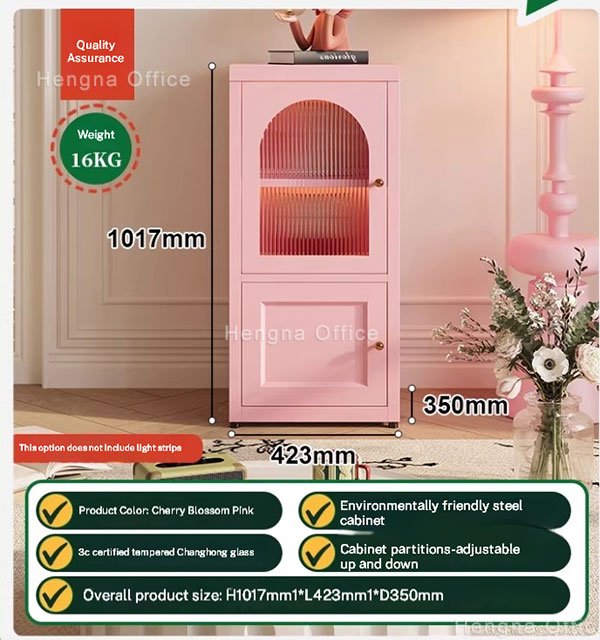
| Overall Dimensions | H1017 × W423 × D350 mm |
| Weight | 16 kg (flat-pack) |
| Shelf Load Capacity | 60 kg per shelf |
| Upper Section | Reed glass door + adjustable shelf |
| Lower Section | Solid steel door (concealed storage) |
| Material | Cold-rolled steel + 3C-certified tempered reeded glass |
| Door Mechanism | Magnetic soft-close catch (<5 dB closing) |
| Handle | Gold-finish round knob (integrated) |
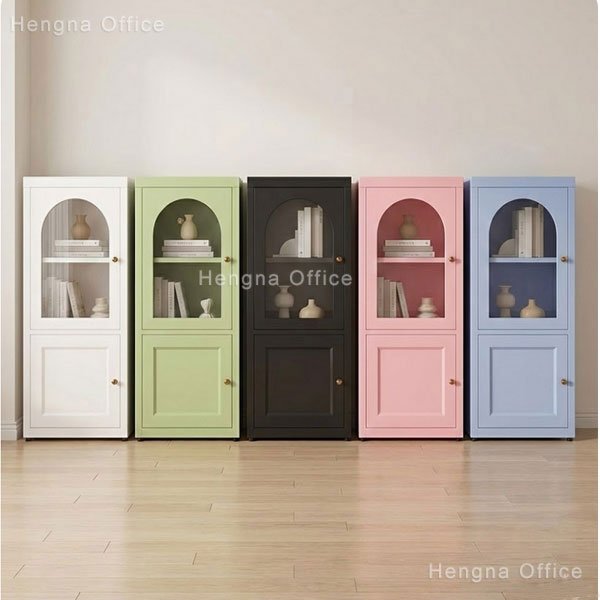
| Colors Available | Dusty Blue, Black, White, Sakura Pink, Sage Green |
| Assembly | Flat-pack (standard) / Pre-assembled (optional) |
| LED Strip | Not included (upgrade option available) |
Pre-Assembled Delivery: Why Renovation Projects Choose It
Flat-pack is the standard shipping method. Assembly takes 15–20 minutes with the included Allen key — no additional tools required.
But for renovation projects — tight timelines, multiple floors, installation crews billed by the day — pre-assembled delivery changes the math:
- Cabinets arrive site-ready. Installation means position and secure — roughly 5 minutes per unit.
- No separate assembly crew needed. One less tradesperson on the schedule.
- Multi-floor projects can receive deliveries floor-by-floor as each level is ready.
The per-unit price difference between flat-pack and pre-assembled is modest. The saving comes from eliminating an entire assembly step across dozens or hundreds of units.
Color Selection for Dining Environments
| Color | Restaurant Types | Why It Works |
|---|---|---|
| Dusty Blue | Seafood, Mediterranean, coastal resort dining | Harmonizes with ocean-toned interiors without competing with food colors |
| Black | Steakhouses, premium sushi, izakaya | Dark finish absorbs ambient light reflections; lets plate presentation stand out |
| White | Cafés, brunch spots, Scandinavian-inspired interiors | Maximizes perceived space — particularly effective in small-footprint venues |
| Sakura Pink | Dessert cafés, afternoon tea venues, floral-themed restaurants | High social media shareability — customers photograph the space, not just the food |
| Sage Green | Organic restaurants, vegetarian cafés, farm-to-table concepts | Natural tone aligns with ingredient-forward, sustainability-driven branding |
All five finishes use powder-coat processing on cold-rolled steel. Batch-to-batch color consistency is maintained within industry tolerance. For multi-location chains placing orders across different shipment dates, specify the color code at time of order.
B2B Procurement
Samples are available for material and workmanship evaluation. Low minimum order quantity keeps trial-order entry manageable.
Standard production lead time is 25–35 days. Shipping terms (EXW, FOB, CIF) and payment methods (T/T, L/C at sight) are negotiable. OEM/ODM is supported — handle styles, surface finishes, and packaging configurations can be customized to your brand requirements.
Contact us to align on specifications, tiered pricing for volume orders, and sample arrangements.
Frequently Asked Questions
Can the reeded glass handle daily bumps in a busy dining room?
Yes. The 3C-certified tempered glass has 4–5 times the impact resistance of standard annealed glass. If it breaks, it fragments into blunt granules rather than sharp shards — the same safety standard required in commercial building codes.
Will the magnetic soft-close weaken over time?
No. The closing force comes from a magnetic field, which doesn’t degrade with use cycles. Unlike spring-loaded mechanisms, there’s no fatigue curve. As long as the installation hasn’t shifted, the closing action remains consistent.
Does pre-assembled shipping increase damage risk?
Pre-assembled units are individually reinforced with additional interior bracing and corner protection. Per-shipment damage rates are comparable to flat-pack. For large-volume projects, discuss packaging specifications in advance.
How do you manage color consistency across multiple store locations?
Same-batch powder coating maintains color within industry tolerance. For cross-batch orders, specify the color code and we can reserve coating material from the same production run to minimize variation.
Can shelf height be adjusted?
Yes. The upper section has multiple shelf-pin positions. No tools required to reposition.
Factory-direct supply. No middleman markup. Sample units available on request.