When you’re sourcing lockers, one question always comes up: ABS plastic or steel — which one lasts longer?
You’ll find plenty of people saying steel is stronger. Others will tell you ABS never rusts. But very few explain the one thing that actually matters — durability means nothing without the environment to compare it in.
This isn’t a sales pitch. It’s a straight comparison. We’re looking at both materials in humid environments — pool changing rooms, spas, beachside resorts, high-moisture factory areas — and breaking down how long each one lasts, why it fails, and what you should actually consider when choosing.
ABS vs Steel Locker in Wet Areas——Short answer first
In dry indoor areas (offices, corridors, school hallways): steel lockers can last 10–15 years. ABS can go 20+. The gap is small.
In high-humidity environments (beachside changing rooms, hotel pools, water parks): steel lockers start showing structural failure at 2–3 years. ABS lockers won’t degrade from moisture within their 20-year design life.
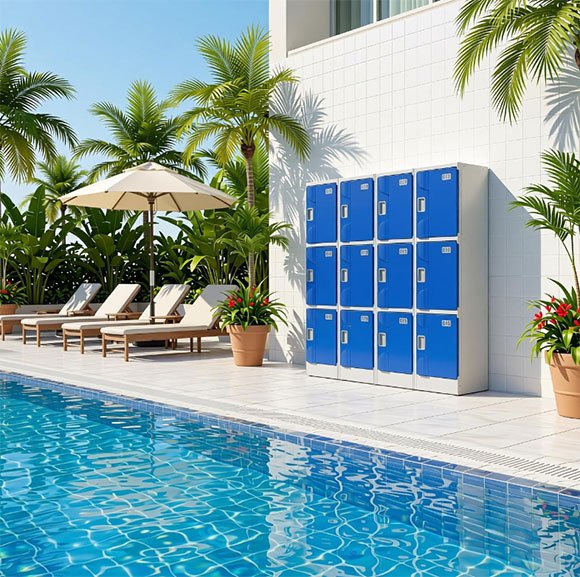
The difference isn’t that one material is “better.” It’s that steel’s physical weakness gets dramatically accelerated in wet environments.
Why steel lockers fail in humid conditions
A steel locker’s protection is entirely in its surface coating. Once that paint gets scratched — from moving, from keys, from daily wear — the exposed steel starts oxidizing.
In a dry office, this process is slow. Surface yellowing after 8–10 years, maybe.
In a high-humidity environment, the chemistry changes.
Chlorine vapor from a hotel pool seeps into scratches and accelerates electrochemical corrosion. Rust pushes out from underneath the paint — bubbling, peeling, flaking. The real problem is at the bottom. Steel locker bases sit flat on the floor. Mop water seeps into the folded metal seam and starts rusting from underneath. By the time you see rust at the corners, it has already eaten halfway through the panel.
Here’s a real example. In 2023, we worked on a renovation project for a resort in Southeast Asia. They had locally sourced steel lockers in an open-air beachside changing room. Salt spray + high humidity. At 2.5 years, the bottom corners started rusting through. By year 3, they removed over 200 units and replaced them all with our ABS lockers. Not because the steel lockers were cheaply made — because the material itself couldn’t handle that environment.
Why ABS plastic lockers hold up
ABS lockers work on a different principle. Protection isn’t from a coating — it’s from the material itself.
ABS is an engineering plastic, injection-molded into shape. The material is waterproof and corrosion-proof throughout. Scratch it, dent it, wear it down — the exposed surface is still the same material. It doesn’t rust. It doesn’t need a coating to protect it.
The structure is different too. ABS lockers use mortise-and-tenon joints. No welded seams, no screw holes. Steel lockers corrode fastest at welds and screw points — ABS has none of these weak spots.
The base is another key difference. ABS lockers sit on an 80mm raised base, molded as one piece with the cabinet. No seam, no gap. When water flows across the changing room floor, it passes right under. No moisture trapped at the base.
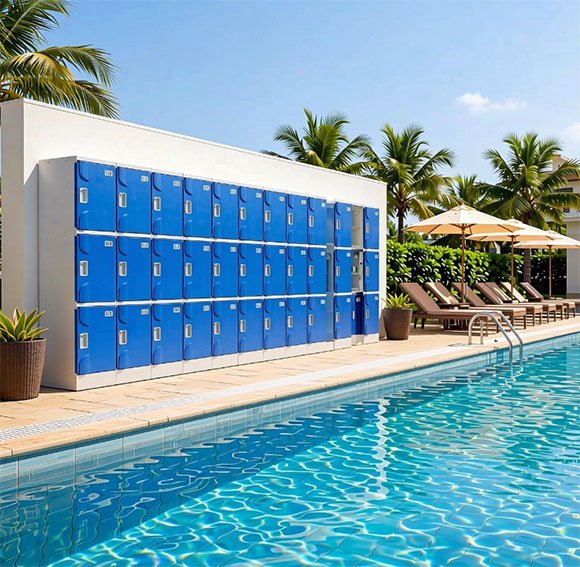
Bottom line: in wet environments, ABS lockers have a design life of 20+ years. Not because they’re “tougher” than steel — because their failure mode in humidity is fundamentally different.
Beyond lifespan — other factors compared
| ABS Plastic Locker | Steel Locker | |
|---|---|---|
| Lifespan in wet areas | 20+ years | 2–3 years (beachside/high humidity) |
| Lifespan in dry areas | 20+ years | 10–15 years |
| Surface scratch effect | No rust, no issue | Scratch site starts rusting |
| Daily cleaning | Wipe with damp cloth | Avoid moisture on surface |
| Assembly | Mortise-and-tenon, tool-free, reusable | Welded or screwed, professional install |
| Color options | 8 standard + wood grain (pigment-molded) | Painted/powder-coated, limited |
| Base moisture protection | 80mm one-piece molded base | Folded metal base, floor-contact |
In dry environments, the difference is small. In wet environments, ABS pulls ahead on every durability metric.
When steel still makes sense
To be fair — not everyone needs ABS lockers.
If your lockers are going in an office hallway, a school corridor, or a dry factory office, steel is a perfectly fine choice. Lower upfront cost, familiar look, no humidity issues.
ABS lockers make sense in wet areas, in environments that require frequent sanitization, and for buyers who care about long-term replacement cost more than initial price.
Quick answers, not a long FAQ
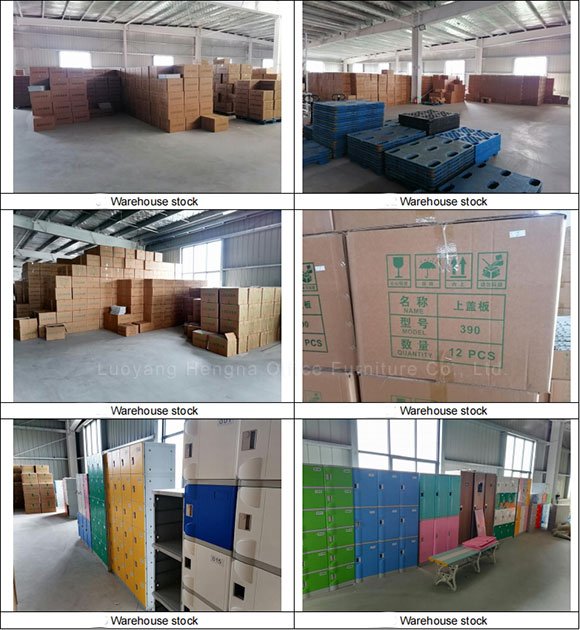
MOQ? 20ft container, 80–120 units depending on door count. Mixed models welcome. Quote turnaround? Send your spec — 24 hours, FOB. Warranty? 1 year, spare parts included. OEM? Silk-screen logo, custom packaging, custom manuals — standard process. Packaging? PE moisture film + corner protectors + foam support + 5-layer corrugated carton. No worries about rust on ABS.
Final take
When choosing a locker, look at the environment first. High humidity — ABS. Dry indoor — steel can work. There’s no winner and loser here. There’s only the right material for the right space.
Luoyang Hengna Office Furniture Co., Ltd. — 9 years in furniture export, CE certified. Send your requirements, we reply with a quote and spec within 24 hours.