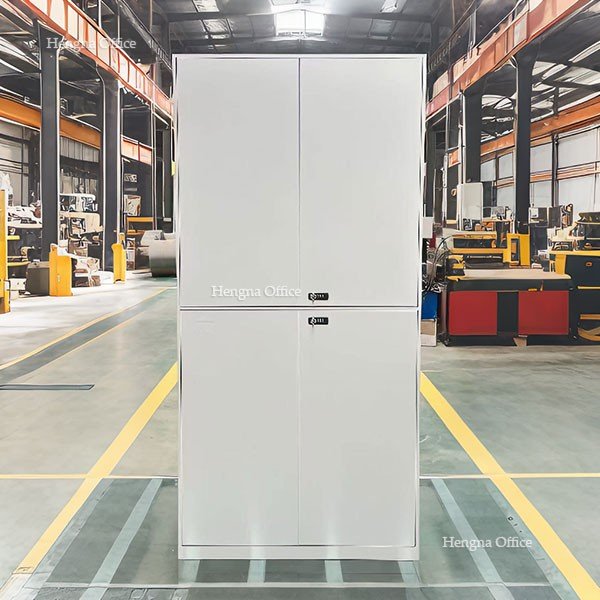
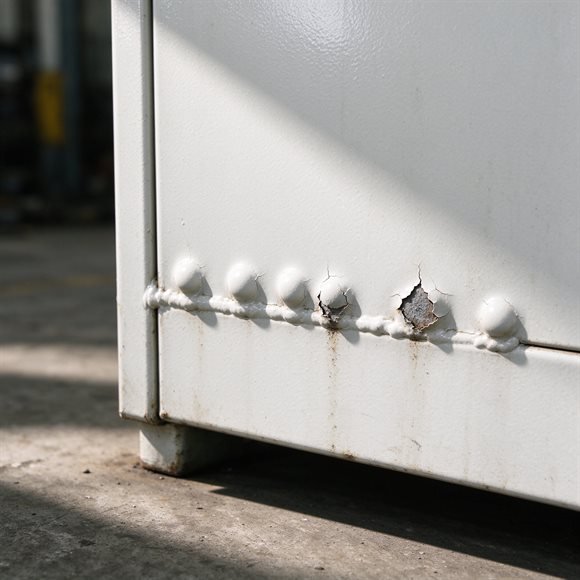
Six weeks after a container lands, the buyer sends four photos. Two doors, a corner of the body, and a close-up of a seam with a row of small blisters along it. The message usually says the same thing: the powder coating has failed, what went wrong with the powder.
Almost never the powder. Powder is a commodity sold by a handful of chemical companies to everyone in the industry. What differs between a cabinet that is still clean after four years in a coastal warehouse and one that bubbles in a single wet season is what happened to the steel in the ninety minutes before the powder went on. That gap is what this page is about, written from the 2026 batches we handle.
Here is the useful part: the place the coating fails tells you which step was skipped. You do not need to test anything to get the first diagnosis.
Where it failed tells you what failed
Three patterns cover most of what comes back from humid markets. They look similar in a photo and come from completely different mistakes.
| What you see | Where it starts | Most likely cause | Usual wrong guess |
|---|---|---|---|
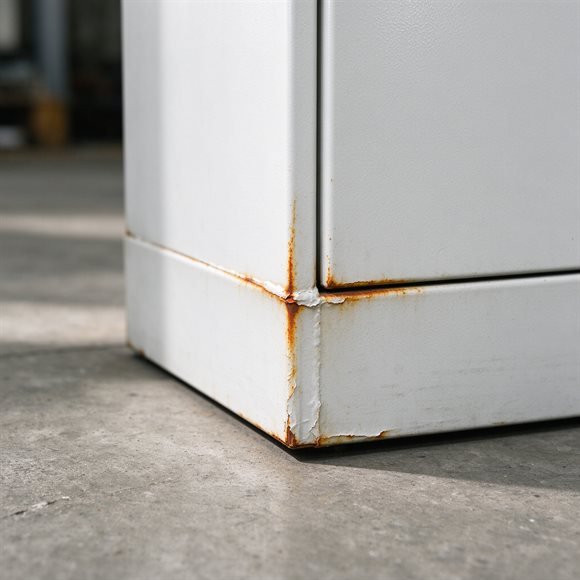
| Rust line along an edge | Door bottom, cut edges, handle openings | Thin film on a sharp edge, bare steel at the cut | “Cheap powder” |
| Blisters in a row | 2 to 3 mm either side of a weld bead | Weld scale or spatter left under the coating | “Bad steel” |
| Thin threads of rust | Spreading sideways from a scratch | Moisture tracking under a coating with weak adhesion | “Sea freight damp” |
A rust line on an edge is a coverage problem. Blisters along a seam are a cleaning problem. Threads spreading from a scratch are an adhesion problem. Three different answers, three different people to talk to at the supplier.
The weld zone is not the same steel
Welding changes the surface it touches. The heat burns off any oil, leaves a layer of oxide that is chemically nothing like the cold-rolled sheet around it, and deposits spatter and silicate residue along the toe of the bead. That oxide layer sits loose on the metal. Powder sprayed over it looks fine because the coating bridges across, and the film is only as attached as the oxide underneath.
There is a second problem specific to seams. A weld bead creates a narrow gap where pretreatment chemicals can enter and not fully rinse out. Degreaser or phosphating solution trapped in that gap comes back out weeks later as a liquid, pushes under the coating from behind, and lifts it in a line of blisters exactly the width of the weld.
This is why weld failures look so orderly. They follow the bead. Nothing else in a cabinet produces that pattern.
What pretreatment has to remove, and what happens when it doesn’t
A powder line runs five steps before the spray booth. Each one exists because of a specific failure that shows up months later if it is skipped or shortened to save time on a busy week.
| Step | What it removes | If it is cut short |
|---|---|---|
| Degrease | Pressing oil, drawing lubricant, fingerprints | Powder bonds to oil, not metal. Blisters start at 3 to 6 months |
| Rinse | Detergent residue | Residue reacts with the next bath and leaves a patchy surface |
| Conversion coating | Bare metal, ready for a chemical bond | Adhesion drops by roughly half; edge rust appears within a year |
| Drying | Water trapped in folds and seams | Steam forms under the powder during cure and lifts it from inside |
| Cure | Nothing. This is where the film cross-links | Under-cured film looks fine, scratches white, and fails early |
The conversion coating is the step buyers ask about least and the one that decides the most. A phosphate or zirconium layer a few microns thick is what gives powder something to grip. Skip it and the coating is only mechanically locked to a smooth surface, which is roughly the same as tape on glass.
Sharp edges get less powder, by physics
Powder is applied electrostatically. The part is grounded, the powder is charged, and the particles fly to the nearest surface. On a flat face that works beautifully. On a sharp outer edge the field concentrates and the film thins; inside a recessed corner the field is shielded and the film thins again. The effect has a name — the Faraday cage effect — and every coater knows it.
A film that reads 70 microns on the door face can be 30 microns over the fold. Nothing looks wrong on the rack. The edge simply spends the next two years with less protection than the panel next to it, and in a humid warehouse that is where the first rust line appears.
Humidity accelerates, it does not cause
It is tempting to blame the climate. A cabinet that failed in a coastal store would probably also have failed inland, just two years later. Water vapour passes slowly through any organic film, and where adhesion is weak it travels sideways along the interface instead of stopping. Warm air and salt speed that up; they do not start it.
This matters commercially. If the failure is blamed on the climate, the fix becomes “buy a different finish”. If it is traced to a step in pretreatment, the fix is a conversation with the supplier about their line, which is where the actual answer lives.
Five questions that get an honest answer
Technical questions get technical answers, and technical answers from a sales desk are worth little. Ask about operations instead — the answers are harder to dress up.
One: what is the line speed, and does it change when orders pile up? Two: how often is the degreasing bath changed, and who signs for it? Three: is there a conversion coating, and is its concentration checked daily? Four: what substrate temperature is reached during cure, measured with a probe rather than read off the oven dial? Five: can you send photos of the welds after cleaning and before coating on our next batch?
That last one is the most useful. Anyone can photograph a finished cabinet. Photographs of the seam between cleaning and coating show whether the spatter was actually removed.
If the batch is already failing
Small areas can be recovered. Grind back to bare metal past the blister, feather the edge of the old film, treat the exposed steel, and build up with a compatible primer and topcoat. It holds, but the repair will never match the original surface exactly, and on a visible door face that difference shows.
Large areas cannot be saved economically. Once rust is tracking under the film along a seam, repainting over it traps the corrosion and it returns within a season. At that point the decision is replacement, and the useful thing is to document the failure pattern before anything is sanded — the pattern is the evidence that supports a claim.
Short answers
Is thicker powder the answer? No. Beyond roughly 100 microns the film becomes brittle and chips more easily. Adhesion under the film matters far more than thickness on top of it.
Does a salt spray certificate settle it? Only if it names the standard and the sample came from a production run. A hand-prepared panel proves what the lab can do, not what the line does.
Can a buyer specify film thickness? Yes, and it is worth putting in writing. 60 to 80 microns on flat faces is normal. Ask for the edge reading as well, because the number that protects a corner is not the number quoted on the panel.
How long should a coated cabinet last in a humid climate? With a full pretreatment chain and a proper cure, five years and often more without edge rust. Without the conversion coating, one wet season is enough to see the first lines.
Hengna supplies powder-coated steel cabinets and lockers out of Luoyang — the 4-door factory locker we ship most often comes off the same coating line — and we would rather answer the five operational questions above than send another catalogue. If you have a batch in service that is starting to show edge rust, send the photos and the installation date and we will tell you which step it points to. Quotes on new orders come back within 24 hours.