A container gets sealed in the afternoon and sails three days later. Whatever is inside it is what your customer receives, and no photo taken at the destination will fix a door that hangs crooked or paint that lifts at a hinge. Pre-shipment inspection exists for one reason: to catch those things while the goods are still on a factory floor, with people around who can weld, repaint or repack them.
The short answer, if you only have thirty seconds: check panel flatness, weld continuity, coating adhesion, door alignment, lock and key control, packaging, and paperwork — in that order. Each one has a number attached to it, not an opinion.
The seal is the point of no return
Buyers often treat the inspection as paperwork for the file. It is really the last moment where fixing something costs almost nothing. A door that needs shimming takes ten minutes on the line. The same door arriving misaligned 6,000 km away becomes a credit note. What an inspection cannot do is guarantee the next 500 units — it samples a batch. That is why the documented pass line matters more than the pass result: it tells you what the factory thinks normal looks like. The pass lines below are the ones we applied to 2026 production batches.
1. Panel flatness, measured with a straight edge
A door can look flat in a photo and still be dished two millimetres in the middle. You will not see it until it is hung against a straight frame, and by then it reads as a quality problem no matter whose fault it is.
Put a one-metre steel straight edge diagonally across a closed door and try to slide a 1 mm feeler gauge under it. Do four doors, from different cartons. Then measure both diagonals of the front opening: more than 2 mm difference and the doors will fight you for the rest of their service life.
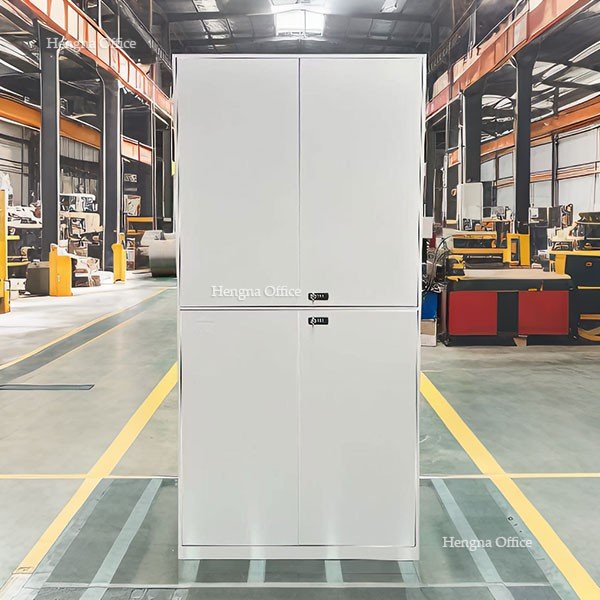
2. Weld continuity at corners and rails
Two cabinets can both be called welded steel and behave nothing alike. Spot welds every 80 mm hold a panel in place but let it flex. A continuous seam along a load-bearing rail is what stops a locker bank from walking across the floor when a dozen people lean on it.
Tap along the seam with a screwdriver handle and listen for a hollow, flat note — that is where the sheets are not fused. Then check the inside of the corner. Uncleaned weld spatter is the most common reason a coating lifts six months later, because powder cannot bond to loose metal sitting on the surface.
| Defect | What it looks like | What it does later |
|---|---|---|
| Blow-through | Hole or crater in the seam | Water path inside; rust starts from within |
| Cold lap | Weld sits on top, no penetration | Joint opens under vibration, door drops |
| Uncleaned spatter | Gritty beads near the weld toe | Coating fails first at these points |
3. Coating adhesion, tested with a blade
Powder coating is only as good as the pretreatment under it. Degreasing skipped, phosphating thin, or dust left on the panel — all three produce a finish that looks perfect on day one and peels in sheets by month eight.
The cross-hatch test takes two minutes. Cut six lines each way, about 1 mm apart, through the coating to bare metal. Press tape over it, press hard, pull at a shallow angle. More than a few specks coming away means the adhesion is not there. Test a flat face, an inside corner and the area next to a hinge — those three get coated from different angles and fail differently.
Read the salt spray report for the standard, not the hour count. A 500-hour claim means little unless it names the method and the lab, and unless the sample came off a production run rather than a panel polished for the occasion. If the batch is going into a wet climate, the coating outranks the panel itself — we compare the two material routes in ABS versus steel in wet areas.
4. Door alignment and hinge count
Doors are where a cabinet gets judged. Measure the gap at top, middle and bottom of the leading edge. A consistent 2 mm gap looks intentional; one that runs from 1 mm to 4 mm looks wrong even when the door closes. Count hinges against door height — three is the minimum above roughly 900 mm. Then open and close twenty doors from the batch, not one.
5. Locks, keys and who holds the master
A brass pin tumbler cylinder and a zinc alloy one look identical from outside and last nothing alike. Ask which is fitted, then ask the key duplication rate — how many locks in a batch open to the same key. Above one in a thousand is worth questioning on a facility with hundreds of compartments — the 4-door factory locker we ship most often uses a brass pin tumbler for this reason.
Settle the master key question before production. If the site needs a management key, the cylinder has to be pinned for it at the factory; it cannot be retrofitted on site. Number every key against its door before the cartons close — a bag of 200 unmarked keys is a problem nobody wants on installation day.
6. Packaging and loading
Damage in transit rarely comes from the ship. It comes from a carton that was fine until something heavy was stacked on it, or a corner that took the hit when a pallet was set down.
Check that each unit has corner foam, a moisture barrier against the coated surface, and a carton rated for the stack height it will actually see. On a mixed container, work the stack out from the bottom up and photograph the loading as it progresses. A photo of the finished container tells you nothing about the bottom of the pile.
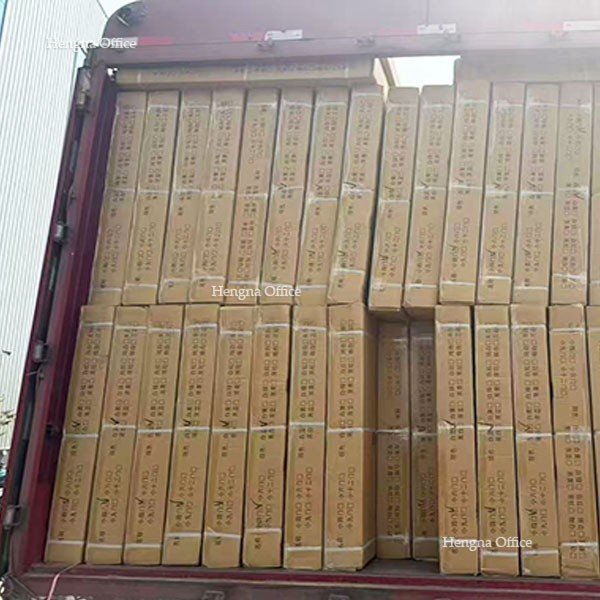
7. The paperwork that decides a claim
If something goes wrong, the claim is won on documents, not argument. You need the inspection report with date and inspector name, the container and seal numbers written on it, timestamped photographs, and the packing list matched against what was loaded. Keep the seal number on the same page as the loading photos — it is the only thing tying the container your inspector saw to the one your customer opened.
An inspection sheet you can hand to a third party
| Check | How to test | Pass line |
|---|---|---|
| Panel flatness | 1 m straight edge, 1 mm feeler | No gap over 1 mm |
| Frame square | Both diagonals | Within 2 mm |
| Weld continuity | Tap test plus visual | No hollow note, no spatter |
| Coating adhesion | Cross-hatch, tape pull | No sheet lift at cuts |
| Door gap | Top, middle, bottom | 2 mm plus or minus 1 |
| Hinge count | Against door height | 3 minimum above 900 mm |
| Lock function | 20 doors cycled | No binding, no latch miss |
| Key marking | Labels against door numbers | 100% marked |
| Packaging | Foam, barrier, carton grade | No exposed coated surface |
| Loading | Photograph layer by layer | Heavy at bottom, seal recorded |
No factory hits every line on every unit, and a supplier who says otherwise has not read their own reports. What you are buying is not perfection. It is knowing where the batch stands before it sails.
Common questions
How long does it take? Half a day to a full day for one container. Mixed shipments take longer because each model needs its own sample set.
Who pays? The buyer normally does, and it is the cheapest line in the order. Firms charge per inspector-day, so batching orders into one visit cuts the cost per container.
AQL 2.5 or 4.0? 2.5 suits finish and alignment defects a customer will notice. 4.0 is common for minor cosmetic marks. Decide before the inspector arrives — it changes the sample size.
Can I inspect every unit? On a small order, yes. On 400 lockers, full inspection costs more than the goods are worth. Sample across cartons, not across one pallet: defects cluster.
What if it fails? The useful outcome is a written list of what to fix, with photos, that the factory signs before repacking. Without that signature you are negotiating from memory.
Hengna supplies steel cabinets, lockers and bed frames out of Luoyang, and we work with buyer-nominated inspection firms rather than resisting them. Send the room schedule or container plan and you will have a quote within 24 hours, plus the packing dimensions to check the loading math yourself.