A trophy case sounds like the simplest line item on a school furniture list. Then it arrives, and the hallway suddenly feels half as wide. Doors can’t swing open, janitors bump the glass with mop handles, and someone decides the cabinet belongs in storage instead of on display.
Most of these problems trace back to six specs that buyers skip when ordering. We build glass display cabinets at our factory in Luoyang and ship them to schools and institutions in more than 40 countries, and the same questions come up on almost every school project. This guide walks through the six checks we recommend before you confirm any bulk order for narrow hallways.

Spec 1: Cabinet depth decides whether the hallway still works
Hallway width is the number schools underestimate. A main corridor needs clear passage width for two students walking past each other, and a trophy case eats into that from day one.
As a rule, keep the remaining walkway at 1200mm or more after installation. On a 1500mm hallway, that means the cabinet should be no deeper than 300mm. On wider corridors of 1800mm or above, a 400mm deep cabinet still leaves comfortable passage. Our standard cabinets run 400mm deep, and we produce slim versions for tighter corridors on request.
Measure the hallway wall first, including skirting boards, radiator covers, and fire hose cabinets. Anything that sticks out eats your passage width, and it is much cheaper to find this on a tape measure than after delivery.
Spec 2: Tempered glass, and why 5mm is the school standard
Regular annealed glass breaks into long, sharp shards. Tempered glass breaks into small, blunt pieces, which is why it belongs anywhere students walk past with backpacks and hockey sticks. For school cabinets, 5mm tempered glass is the practical standard: thin enough to keep the cabinet light, thick enough for daily contact and door slamming.
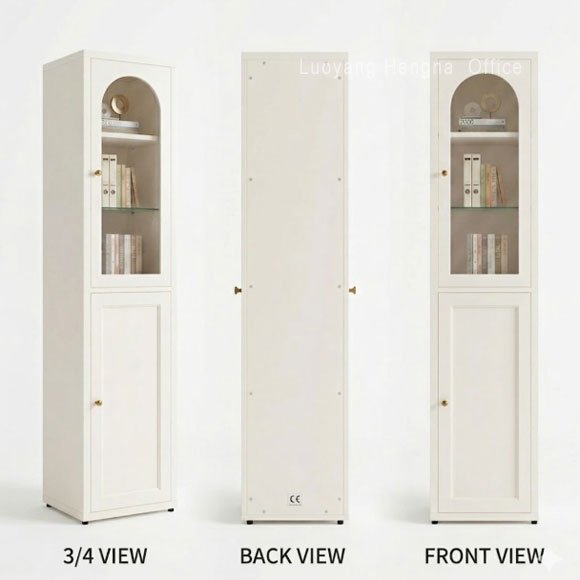
Check two details beyond thickness. First, ask whether the glass edges are polished or protected; raw cut edges chip over time when doors are opened hundreds of times a term. Second, ask how the glass bonds to the frame. Our small-format cabinets use a sealed edge treatment on the glass, and every glass panel in our range is tempered as standard, not as a paid upgrade.
Spec 3: Lockable doors are the spec principals actually ask about
Trophies get touched. Students tap the glass, try the doors, and occasionally test whether the 2024 championship cup lifts out. A cabinet without locks in a school hallway becomes a display problem within one semester.
Two lock layouts exist. Twin-door cabinets can share one center lock on the meeting stile, or each door can carry its own lock. For schools we recommend one keyed lock per cabinet section, with keys held by the office. If a trophy case sits in a public lobby where staff rotate, keyed-alike options let one key open every cabinet in the row, which simplifies handover between semesters.
Spec 4: Adjustable shelves handle real trophy collections
Trophy sets are never uniform. A single case might hold a 600mm shield, a row of 200mm cups, and a flat plaque board. Fixed shelves force awkward stacking, and tall trophies end up on the floor next to the cabinet.
Look for shelves with multiple height positions, ideally adjustable in 50mm to 80mm steps. Glass shelves should carry heavy cups without flexing; steel-framed shelves with glass panels handle the load better than all-glass shelves on plastic clips. Ask the supplier for the load rating per shelf, and confirm it covers your heaviest team shield, not just the average cup.
Spec 5: Steel frame and powder coat finish survive school corridors
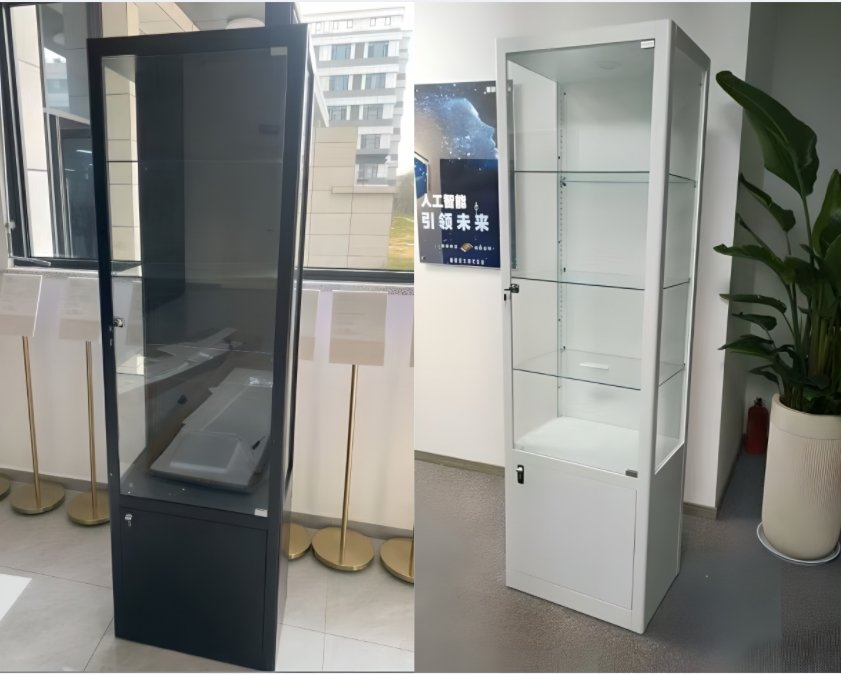
Wood veneer cases look formal in a brochure and age badly in a hallway. Kick plates get kicked, edges get chipped, and humidity in holiday-closed buildings lifts the veneer. A cold-rolled steel frame with electrostatic powder coating handles contact, cleaning chemicals, and damp classrooms far better.
Two checks here. Confirm the steel gauge for the frame; thin sheet metal flexes when the cabinet is moved during floor cleaning. Then confirm the coating is baked powder coat, not spray paint, because spray paint chips at the bolt holes and door edges where handling is constant. Powder-coated steel frames also let you match school colors, which turns a storage unit into something the alumni office actually wants in photos.
Spec 6: Flat-pack shipping and how the cabinet arrives
A fully assembled 2000mm glass cabinet does not pass through a standard classroom door, let alone a service elevator. Schools almost always need knock-down (KD) construction: the steel frame ships flat, the glass ships in protective crates, and assembly happens in the hallway.
Ask three questions about arrival. How is each glass panel packed between the factory and your site? What tools does assembly need? And how long does one cabinet take to put together? Our KD cabinets are designed for boltless main-frame assembly, so two people can stand a cabinet up and fit the glass shelves in under half an hour with basic hand tools. On a ten-cabinet hallway project, that is the difference between a one-day install and a lost week.
Sizing reference for narrow hallway projects
The table below shows how cabinet depth affects remaining walkway on the two most common school corridor widths, using a single row of cabinets against one wall.
| Hallway clear width | Cabinet depth | Remaining walkway | Verdict for student traffic |
|---|---|---|---|
| 1500mm | 300mm | 1200mm | Acceptable |
| 1500mm | 400mm | 1100mm | Tight; only for low-traffic zones |
| 1800mm | 400mm | 1400mm | Comfortable |
| 1800mm | 500mm | 1300mm | Acceptable, watch door swing |
| 2400mm | 400mm | 2000mm | Comfortable; island placement possible |
Door swing matters as much as depth. Hinged glass doors need clearance in front of the cabinet; sliding or bi-fold glass doors remove that problem entirely in tight corridors. If the hallway is under 1500mm, ask for sliding doors before you ask for a discount.
Mistakes we see on school trophy cabinet orders
The most common one is ordering on height alone. A 2000mm cabinet fills a wall nicely, but buyers forget to check diagonal dimensions when moving crated panels through older buildings with narrow stairwells and corner turns.
The second is skipping the lock spec to save a small amount per unit, then retrofitting padlock hasps that look worse and work worse. The third is assuming shelf load without asking; a row of metal shields can weigh more than the cabinet itself. Each of these is a five-minute question at order stage and a much harder conversation after delivery.
How we build school cabinets at our factory
Our cabinets pair a cold-rolled steel frame with 5mm tempered glass and electrostatic powder coating in standard black or white, plus custom RAL colors for school branding. Shelves adjust in multiple positions, doors come hinged or sliding, and every unit ships knock-down with glass crated separately.
Because we manufacture in Luoyang and export direct, school districts and contractors can order hallway rows of ten, twenty, or more cabinets in mixed depths, with dimensions adjusted to the building instead of the other way around. Bulk projects get factory-direct pricing and consistent batches, so cabinets ordered in different terms still match in color and hardware.
Common questions
What depth should a trophy cabinet be for a 1500mm hallway? 300mm or less, which keeps 1200mm of clear walkway. If your trophies need deeper shelving, consider a recessed alcove or a sliding-door cabinet at 400mm.
Can the cabinet be fixed to the wall? Yes. Wall anchoring brackets are recommended in student areas, and the steel frame has pre-drilled points for fixing to masonry or stud walls with the right anchors.
How are the glass shelves and doors protected during shipping? Glass panels ship in individual foam-lined crates, separated from the steel frame. Knock-down packing also keeps each carton under standard freight handling limits.
Can we order cabinets in our school colors? Yes. Powder coating is available in custom RAL colors, so the frame can match school branding. Minimum quantities apply per color batch, which your supplier should confirm before sampling.
How much weight can each glass shelf hold? Ask the supplier for the per-shelf load rating in writing. Our steel-supported glass shelves are rated for heavy trophy loads, but ratings differ across the market, and a written figure protects both sides.
Do sliding doors still lock? Yes. Sliding glass doors use lockable handles at the frame, and they are the better choice for corridors under 1500mm because they need no swing clearance.
The short version
For narrow school hallways, check depth against walkway width first, insist on 5mm tempered glass with finished edges, get keyed locks on every section, confirm adjustable shelf load ratings, choose powder-coated steel over veneer, and make sure the cabinet ships flat-pack so it actually reaches the hallway. Answer these six before you wire a deposit, and the trophy case ends up in the corridor doing its job instead of in storage doing nothing.
Planning a hallway row or a whole-campus rollout? Send us your corridor measurements and trophy list, and our team will spec the cabinets, confirm colors, and quote factory-direct with shipping to your port.
Keep reading
Curio Cabinet for Collectors: How to Display Action Figures and Collectibles Behind Glass
Tall Cream White Display Cabinet 78 Inch: Glass Storage for Tiny Homes and Narrow Rooms
Slim Narrow Display Cabinet 40cm+ Wide: Tall Steel Glass Cabinet for Short-Term and Vacation Rentals