A batch of 200 beds can make or break a camp
When a mining company or a construction contractor orders 200 single beds for a worker dormitory, the beds get used harder in one year than hotel beds get used in ten. Workers come off 12-hour shifts, boots still dusty, and drop onto the frame. Cleaning crews mop around the legs every week. Windows stay shut in humid seasons. In that kind of environment, a bed that looks fine in a showroom photo can start squeaking, rusting, or wobbling within months.
We roll-form steel bed frames in Luoyang and ship flat-pack beds to labor camps, mining sites, and staff housing projects in more than 40 countries. Most of the problems buyers run into are predictable and avoidable at the ordering stage — before anything gets welded or packed. This guide walks through the six things worth checking, with the actual numbers we use on our own production line.
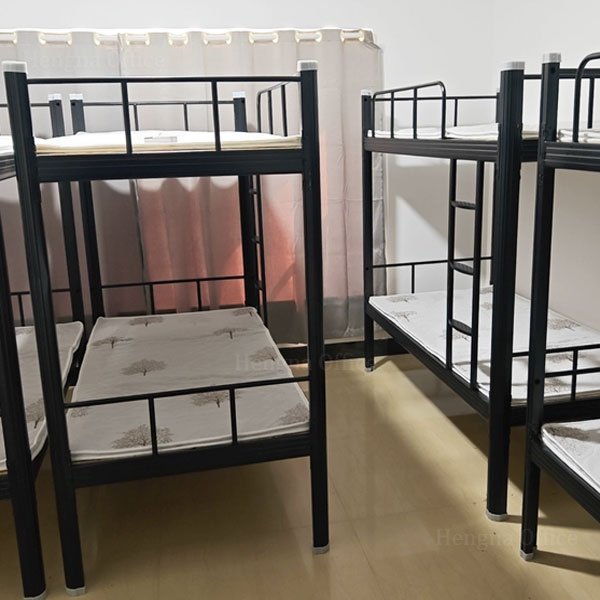
Start with the frame steel, not the price
The first spec to ask a supplier is not the price per bed. It is the column and rail profile. Two beds can both be called “metal single bed” and still behave completely differently after a year in a camp.
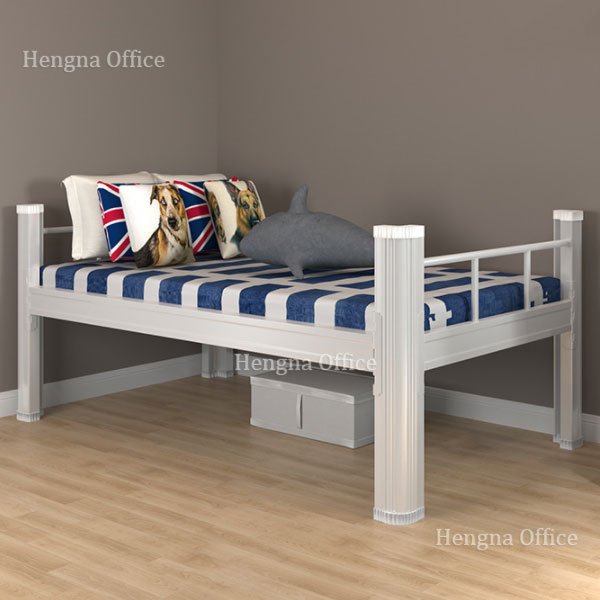
Our single bed (model HN-1001, 2000 x 900 mm) uses a roll-formed column of 83 x 63 mm with a 1.0 mm wall thickness, and the side rails are roll-formed 93 x 35 mm profiles with two reinforcing ribs pressed into each rail. Roll-formed profiles carry load better than the same weight of square tube because the shaping process puts extra stiffness where it matters. The double rib along the rail is what stops the mid-span sag you feel on cheap beds when a worker sits on the edge.
When you compare quotes, ask three questions: What is the column profile and wall thickness? Is the rail roll-formed with ribs, or plain tube? What is the steel — cold-rolled or hot-rolled? Cold-rolled sheet has a cleaner surface and tighter thickness tolerance, which matters for powder coating adhesion. If a supplier cannot answer these three questions in one email, that tells you something too.
Rust-proofing: match the coating to the camp
Rust is the number-one killer of steel beds in worker housing, and the right coating depends on where the camp sits. There is no single best option — only the right option for your site.
| Coating | How it works | Best for | Watch out for |
|---|---|---|---|
| Electrostatic powder coating | Charged powder sprayed on, cured in an oven | Dry inland camps, standard dorms | Edges and welds need good pre-treatment or chipping starts there |
| Pre-galvanized steel + powder coat | Galvanized sheet formed, then coated | Humid coastal regions | Cut edges expose bare zinc-free steel unless re-treated |
| Hot-dip galvanizing | Whole frame dipped in molten zinc | Mining camps, high-humidity sites | Heavier, higher cost, surface less smooth |
For most staff dormitory projects we recommend electrostatic powder coating with a proper phosphate pre-treatment bath. The pre-treatment step is the part buyers never see and the part that decides whether the coating stays on. Ask your supplier how many tanks their pre-treatment line has — a four-tank line (degrease, rinse, phosphate, rinse) is the minimum we would accept for camp conditions.
If the camp sits on a coastline or handles ores that hold moisture, upgrade to pre-galvanized sheet under the powder coat. The extra cost per bed is small compared with replacing a corroded frame two years in. For a closer look at how we spec beds for camp conditions overall, see our steel bunk beds for labor camps guide — the coating logic is identical for single beds.
Load capacity and the points where frames actually fail
Buyers often ask “how many kg can it hold?” — but the honest answer is that beds do not fail in the middle of the span. They fail at the joints. The three failure points to check are:
1. The corner joints. On screwless designs, the connection is a buckle-and-slot system. On welded or bolted frames, look at whether the bolt passes through reinforced sleeves or just through the thin wall of the tube. A bolt through a 1.0 mm wall will chew loose after repeated assembly moves; a bolt through a welded sleeve will not.
2. The side rail to column connection. This is where workers kick the frame getting out of bed and where cleaning trolleys bump it. Our rails hook into slots formed into the column profile, so the load transfers through steel-on-steel contact rather than through a bolt in shear.
3. The center support. A 900 mm wide bed with a single center leg is fine for a guest room. In a camp, where a mattress sits directly on slats and workers store gear underneath, check that the leg has a protective floor pad and a welded top plate — not a bare tube end.
A practical test any buyer can run: load the assembled bed with stacked bags to roughly 300 kg, centered, and push the top rail sideways. A well-built frame flexes and comes back. A weak one creaks, and the creak gets worse every month after delivery. The same joint logic applies to our heavy duty metal bunk bed frames, which share the column profile with this single bed.
Flat-pack or assembled: the container math
This is the spec that quietly decides your landed cost. A knock-down single bed packs flat; an assembled bed ships as a bulky finished product. For camp projects the difference is huge: one 40 ft high-cube container can carry roughly 200 flat-packed single beds, while the same container fits only 40 to 50 assembled ones, depending on stacking design.
That means for a 200-bed camp, flat-pack shipping is one container instead of four. Even after you add local assembly labor, the numbers usually favor knock-down — and assembly with a buckle design runs fast because there are almost no bolts to align. We cover the knock-down approach in detail in our guide to portable knock-down steel bunk beds for construction site camps, and the same packing logic applies to single beds.
If your contractor has plenty of site labor and tight shipping budget, order flat-pack. If the camp is remote and skilled labor is scarce, ask for pre-assembled column-and-rail modules that fold once instead of full assembly — some suppliers (including us) can do this middle option on request.
Assembly speed on site
Camp schedules slip when hundreds of beds each take an hour to build. With a buckle-slot design, two workers with rubber mallets assemble one single bed in roughly 10 to 15 minutes once they have done the first one. No power tools, no loose hardware to sort, nothing to over-tighten.
Check with your supplier: Are assembly instructions pictorial? Are all beds in the shipment identical in hardware? A mixed shipment where some beds use bolts and some use slots turns a one-day job into a three-day job. Also confirm that spare connection parts ship with the order — one missing buckle in a shipment of 200 beds will stall an assembly line.
Ventilation, hygiene and the bed board
Worker dormitories in humid regions have a hygiene reality that catalog photos ignore: sweat, dust, and the constant risk of bed bugs moving through a camp. The bed base matters more than most buyers think.
We use a wood-grain slat board with anti-slip strips rather than a solid steel plate. Slats let air move under the mattress, which dries out moisture and makes bug inspection simple — a worker or nurse can lift a mattress and see the whole base in seconds. Solid steel plates trap humidity against the mattress underside and turn into rust trays.
For camps that run rotation shifts, ask about bed frames with smooth surfaces and rounded corners so cleaning crews can wipe frames quickly. Every detail that speeds up weekly cleaning extends the life of the whole dormitory furniture set.
Dimensions that fit global rooms
The standard single bed size for camp projects worldwide is 2000 x 900 mm, with a frame height around 750 mm at the sleep surface. That fits a standard mattress and leaves a 700 mm-plus walkway in a typical 3.2 m wide dorm room with beds in a row. If your rooms are tighter, the same frame accepts a 1900 mm length; if workers are taller (common in some European and African projects), suppliers can stretch the length on custom runs.
| Dimension | Standard (mm) | Note |
|---|---|---|
| Length | 2000 | 1900 mm option for smaller rooms; custom runs on request |
| Width | 900 | 1000 mm option for senior staff rooms |
| Frame height | 750 | Sleep surface height, fits standard mattress |
| Under-bed clearance | ~150 | Depends on leg design; enough for a storage box |
One practical tip: measure the dorm room door and corridor widths before you order. A flat-packed bed box is roughly 2 meters long — if the corridor turns at 90 degrees with less than 1 meter of clearance, ask your supplier for two-piece side rails that connect in the room.
Common ordering mistakes we see every quarter
Ordering by lowest price per bed. The cheapest quote usually means thinner rails, fewer pre-treatment tanks, and slat boards replaced with cardboard honeycomb. In camp use, those beds age out in 18 to 24 months and the “saving” turns into a repurchase.
Skipping the sample step. For orders above 100 beds, always get one sample bed, load it, move it, and re-assemble it before the container ships. It costs little and catches almost every manufacturing surprise.
Forgetting spare parts. Order 2 to 3 percent spare connection parts and one extra slat board per 50 beds. Camps move beds between rooms constantly, and small parts disappear.
Ignoring color early. Powder coat color is chosen at the coating stage. Deciding “we want dark blue frames” after production starts adds weeks. Decide RAL codes when you sign.
Assuming all “single beds” are the same size. A bed quoted as “single” might be 1900 mm or 2000 mm long, 750 or 900 mm wide. Lock the millimeter dimensions into the purchase contract, not just the word “single.”
FAQ
Q: What gauge steel is best for a worker dormitory single bed?
A: Look for 1.0 mm cold-rolled steel in roll-formed profiles for columns and rails. Below 0.8 mm wall thickness, frames start denting and creaking within the first year of camp use.
Q: How long does a powder-coated metal single bed last in a camp?
A: With proper phosphate pre-treatment and indoor use, 8 to 12 years is realistic. In humid coastal camps without galvanized steel, expect visible corrosion in 2 to 3 years — upgrade the coating instead of the price.
Q: How many single beds fit in a 40 ft container?
A: Roughly 200 flat-packed single beds of 2000 x 900 mm in one 40 ft high-cube container. Assembled beds cut that to 40-50 units, which multiplies your freight cost.
Q: Can we get beds in our company color?
A: Yes. Powder coating accepts any RAL code. Give the RAL number at order confirmation so the coating line batches your color correctly — this avoids delays later.
Q: What is the difference between a buckle design and a bolted bed frame?
A: Buckle designs slot together with no loose bolts, assemble in 10-15 minutes with a mallet, and keep their tightness through repeated moves. Bolted frames are strong but loosen over time as workers move beds and bolts back out.
Q: Do you supply matching wardrobes and lockers for the same dormitory?
A: Yes. Most camp buyers order beds together with steel wardrobes and storage lockers so the whole room ships in the same container, in matching colors, with one production schedule. Ask your supplier to quote the room as a set.
Get a factory quote for your camp project
Send us your room dimensions, bed quantity, and destination port. We will confirm the frame spec, coating package, container loading plan, and lead time in one reply — usually within 24 hours. No middlemen, factory direct from Luoyang.